A Flag at Both Ends of Hope Street (Or the Genealogy of Theology)
For immediate context I would like to establish that I am Anglican in essentially the same way that most people raised in the North-West of England are Anglican, which is to say culturally, somewhat socially, and certainly without any particular theological stringency having been applied to the question of systemic faith at any point during my childhood conditioning. My parents weren’t religious; nobody sat me down with a copy of the King James, and church attendance was reduced to the annual, hour-long slot of Christmas carols and the regularly uninspired (though thankfully milk-abundant) school trip. Thus to me English Protestantism is, at least the variety native to this latitude and demographic, essentially a Viking form of Christianity: accept Christ as Lord and get on with your life. It’s a faith of pronounced minimalism, and I for one have always found that quietly admirable if not tremendously exciting — perhaps because it requires so little of one’s unconditional servitude whilst technically remaining on the ‘good and proper’ pages of the Logos. In other words, it doesn’t take a history boffin to parse that it’s a denomination promulgated by a very Germanic conception of the transcendent, with its skeletally Norse pagan orientation unmistakably native to this cloud-infested corner of Europe.
I mention this not so much as a disclaimer but as a precisely pitched narrative framework, because it turns out to be exactly relevant to what the world’s fifth largest cathedral does to a person when they walk into it.
By the way, I should like to add that my patrilineal line is Dolan — an ancient Gaelic warrior caste in origin and apparently later Norse-infused if Y-DNA haplogroups are anything to go by — who, somewhere in the subsequent generations of the late Edwardian period, had the socially-aware good sense to marry into the English Howards on my paternal grandmother’s side, a genealogically renowned lineage of Old Lancashire stock whose idea of theological commitment was, not unlike my own, largely confined to J&B Scotch and a gentleman’s agreement not to ask too many questions. The result of this particular union is that I am, depending on which paternal grandparent’s legacy one consults, either a lapsed Irish Catholic who never quite started or an English Protestant who never quite bothered. Which is, arguably, a fairly representative summary of the English – nay, British – religious condition in general. What I can tell you with historical certainty is that my war-wearied grand-da Dolan contributed industrial paintwork to the construction of the Catholic Metropolitan Cathedral up the road — aye, the one Scousers sardonically refer to as “Paddy’s Wigwam” because it’s so bloody strange-looking — whilst his linear descendants were raised, without apparent irony, to appreciate the more refined and aristocratic Anglican counterpart. There is, I suspect, something very Liverpudlian about that expression of rivalry. The two cathedrals sit at opposite ends of the allegedly Masonic-engraved Hope Street, facing each other across approximately half a mile of Merseyside ambivalence, and my own bloodline appears to have discreetly planted a flag at both ends without making any particular fuss about it. Well, until now, of course. I used to joke that having both English and Irish ancestry is tantamount to having schizophrenia, but I stopped saying that when I met actual schizophrenics on Lime Street. So I won’t joke about it anymore…
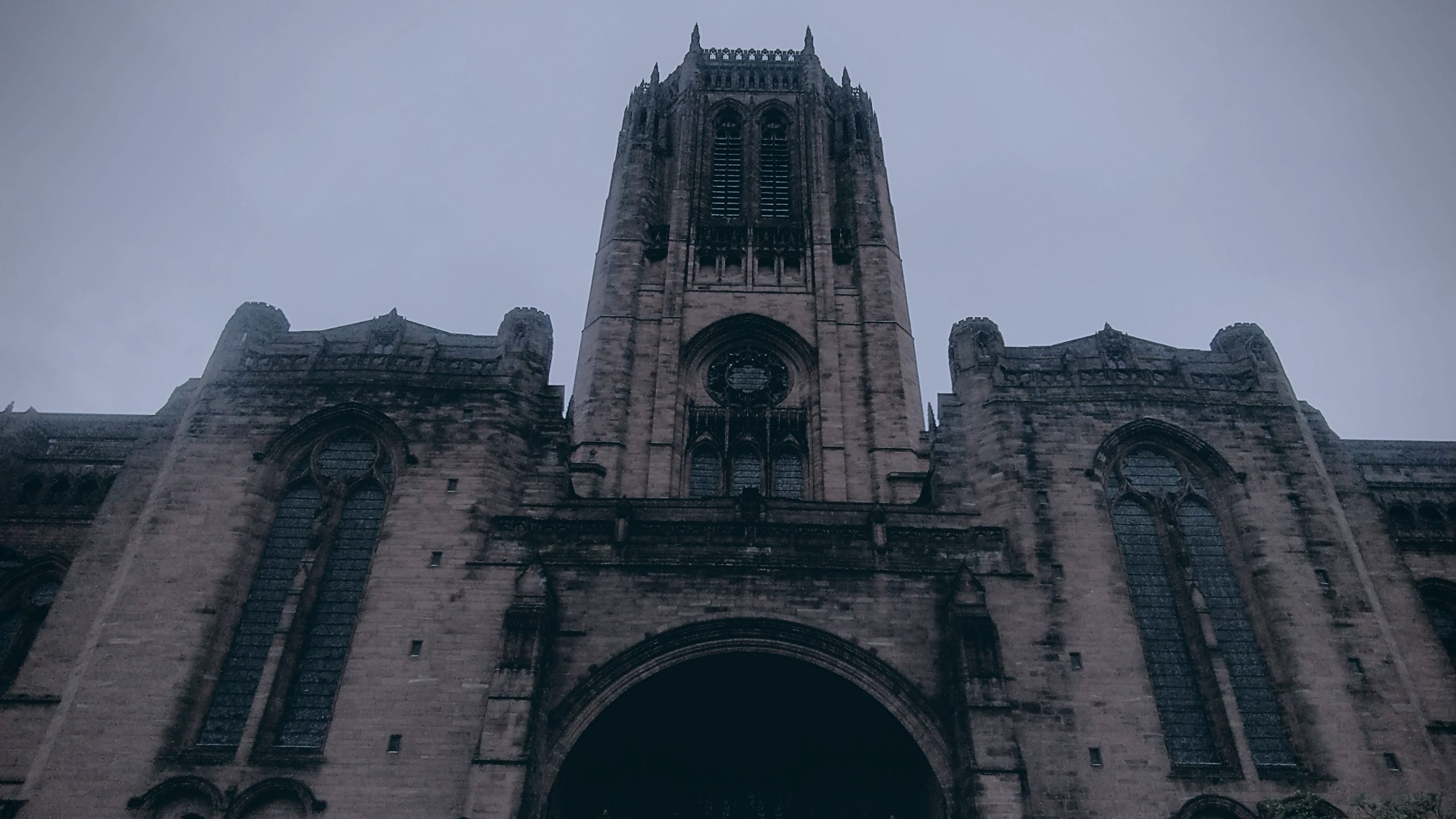
The building is situated high on St. James’ Mount, constructed from Woolton sandstone that varies in tone according to the hour and whatever the Mersey sky has decided to inflict upon you that afternoon. From the outside it is formidable in the way serious, unapologetic architecture tends to be. From the inside it becomes something rather more difficult to categorise by means of linguistic brevity, and I say that as someone constitutionally disposed towards a discerning and healthy scepticism in relation to the ineffable, as modern journalists are expected to be.
What actually happens when you walk in, however, is considerably less dramatic than the statistics have prepared you for, which turns out to be precisely the point of its creation. The city’s traffic-laden ambience audibly stops upon immediate entry, with the clean resolution of a door closing on a conversation that was never going anywhere particularly interesting. What you’re left with is a sense of sonic quietude I’m not sure I’ve encountered in quite this architectural configuration before; not quite the demanded silence of a library or the rigid hush of a concert hall awaiting performance, but something older and much less interested in one’s interpretation of it. A handful of other visitors navigate it at the particular pace that spaces of this seriousness tend to impose on people without negotiation; sauntering, slightly sedated, instinctively aware that whatever they came in carrying is now marginally less relevant than it was on the drizzle-sopped steps outside (vaping and Instagram notifications included). The voluminous, cave-like interiority is its true selling point though. You look up and the tower continues past any point at which looking up remains a comfortable activity, and you make a private note of its capacity and move on, because the building has already stopped waiting for your reaction and returned to whatever it was doing before you arrived. Which, I earnestly proffer, was very much this: the light coming through the sandstone in that particular deliberate and un-hastened way, the ambiance going about its untroubled yet mellifluous business, and the whole arrangement of its meticulous confines entirely unperturbed by the century that has passed through it. And this I rather liked.
Thus, the interior volume alone warrants your full attention before anything else competes for it. A quick Google search informs me that the building’s internal length spans 480 feet (150m) and the central tower space rises to a height at which the human figure is rendered essentially decorative at 331 feet (100.8m). The arches are also reputedly the largest Gothic arches ever constructed, a claim I shall repeat with the cautious reverence one normally reserves for Google-generated statistics. The organ, however, is certainly the largest working church organ in the United Kingdom, and the bells are the world’s heaviest and highest ringing peal. These are the sorts of facts that read as economically motivated boosterism in a tourist’s pamphlet and become simply accurate when you’re standing underneath them, recalibrating your sense of proportion in real time while you’re recording it and trying not to trip over the steps.
The history is, characteristically for this country, a rather impressive study in obstinate continuation against all reasonable odds. The 1901 design competition was won by a precocious 22-year-old named Giles Gilbert Scott, which is already an improbable premise for a building of this ambition. Construction began in 1904 and the cathedral was finally completed seventy-four years later in 1978, absorbing two world wars, imperial collapse, and several infamous decades of the city’s own turbulent relationship with economic fortune (you may have heard the eighties weren’t a good time here). George VI and the Queen Mother visited the city during the Blitz, a gesture that can hardly have hurt morale among the building’s mortar-stained grafters. And I dare say there is something very specifically Union Jack-coded in that image — the city ablaze, the bombs falling with indiscriminate regularity, and someone making the measured executive decision that the cathedral must nonetheless continue its substantive and aesthetic grandeur. These Viking Christians, one suspects, would have found it entirely unremarkable. Just get on with it and finish the shift with a pint of Caine’s and some sourdough, lads.
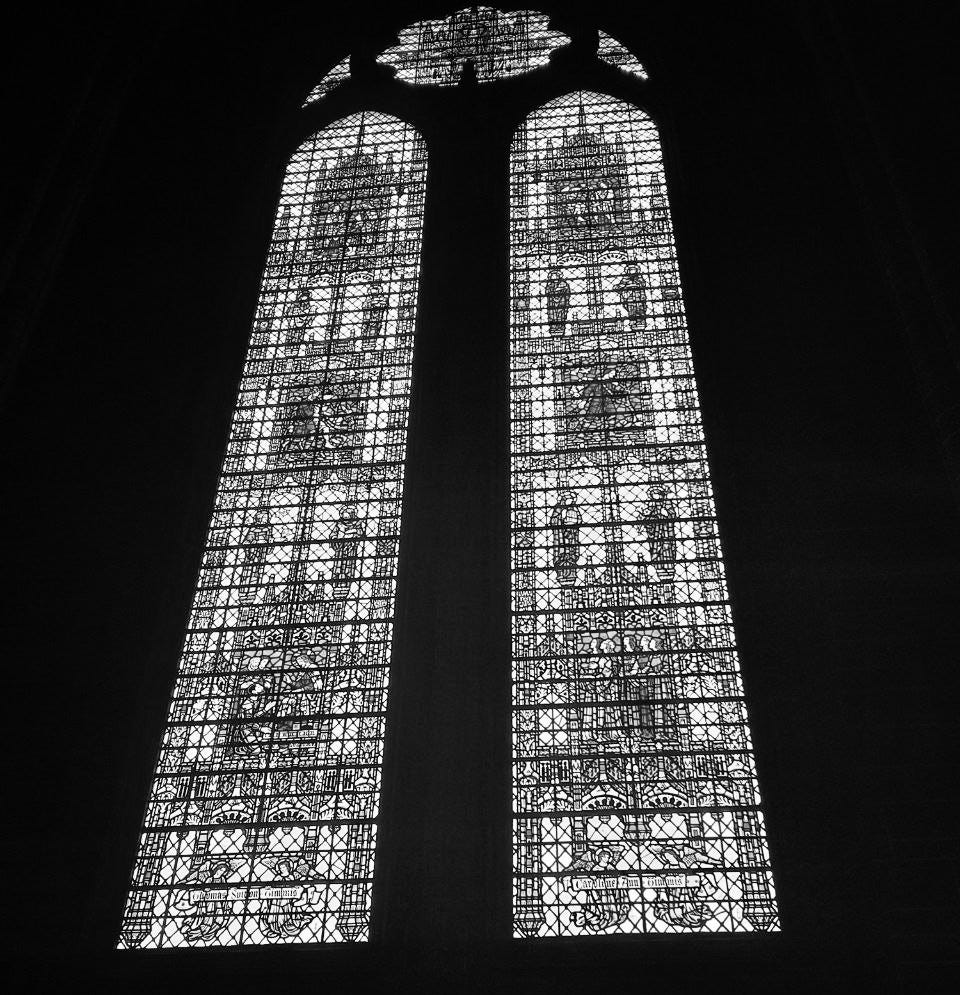
All this solemn sensory detail got me to thinking about Luther and the entwined Protestant and musical ethos. I should note, as a composer and music journalist, that I find it privately gratifying that the tradition I nominally belong to turns out to have rather strong and life-affirming opinions about the metaphysics of sound, for it resonates, one might say, professionally as much as spiritually. Luther was, among his many forcefully held positions, theologically serious about music in a way that went well beyond aesthetic preference. He played the lute, wrote hymns himself, and declared music ‘second only to theology’ as a gift sent straight from the Divine, which, depending on your disposition, is either a profound statement of faith or the most consequential argument a musician has ever made for his own professional relevance. The Protestant tradition inherited this conviction with a deeply serious confidence, and the cathedral proceeded to honour this fact with characteristic Northern restraint by installing what is currently the largest pipe organ in the UK. 10,268 pipes, 152 speaking stops — the largest pipe standing at ten metres tall — all of it constructed by Henry Willis & Sons and installed between 1923 and 1926 whilst the building around it was still, with established British stubbornness, yet to be finished. This year, as it happens, marks the organ’s centenary, being celebrated with a series of six world-class recitals across 2026. Luther wanted music to fill the congregation’s lungs and lift the soul towards something it couldn’t quite name. In the spirit of full genealogical disclosure, my grand-da — for whom God and the foreman had, on that one occasion, wanted precisely the same thing — never, to my knowledge, set foot in this building. The organ he never heard has, in the intervening century, accumulated rather more cultural consequence than either of us might reasonably have anticipated. Liverpool’s soldiering construction workers, apparently, took that as a technical specification and spent a century scaling up accordingly.
What I ultimately found was that the building possesses a quality genuinely rare in modern life and which resists easy articulation without sliding into the journalistically mawkish. One gets the distinct impression that the building has been quietly at this since long before you arrived and will continue without interruption once you’ve gone. Which, upon current reflection, is either a humbling or a consoling thought depending on the afternoon you’ve had. And I had a nice one, personally.
For someone who acknowledges his faith lightly and with considered theological aloofness in roughly equal measure, that felt like exactly the right amount. But there is, I’d argue, something more honestly devotional in that arrangement than in any building that so evidently and ostentatiously exudes its sacred gravitas at you — though I accept that observation may say more about my priestly-caste temperament than about ecclesiastical design philosophy.
The video tour is above; go in person if you get the chance, it rewards the nonchalant wandering soul. My grand-da's cathedral is just half a mile up the road, if you fancy the aesthetic comparison. And who knows, perhaps Paddy's Masonic monstrosity will get its own investigative treatment in due course. By familial accounts neither of us was especially devout to either denomination, but both of us, in our respective ways, at least had the communal decency to show up for the architecture.
Sources:
https://www.garethedwardsmusic.co.uk/the-grand-organ-of-liverpool-cathedral/
https://liverpoolcathedral.org.uk/cathedral-music/organ/
https://en.wikipedia.org/wiki/Henry_Willis_&_Sons
Words and photography by Jack Dolan